

Most of the time, when someone calls themselves lazy, they’re not describing who they are. They’re describing what their environment is producing.
That’s a meaningful difference. And it took a while to understand it from the inside.
I can remember a specific season of life that had a very particular weight to it. My wife was working full time and finishing her Master’s Degree at the same time. I was also working a full time job and trying to grow a website design business I had just started. Add in four boys ranging from a toddler to a 16-year-old, and the math is already clear before I finish the sentence.
A family of six where every adult was already past capacity before dinner.
Free time wasn’t just limited. It was almost theoretical. Whatever was left after work, school pickups, homework help, bedtime routines, and trying to keep a marriage present in the middle of all of it, that was the margin we had. And it wasn’t much.
That kind of season has a specific feeling to it. Not crisis, but close to full. You’re not drowning but you’re not floating either. You’re just moving, day after day, keeping the most important things upright and quietly letting the rest slide until the weekend, when you tell yourself you’ll catch up. The house isn’t falling apart but it’s not getting ahead either. Everything is maintenance. Nothing is growth. And somewhere in the middle of all that, you stop noticing what you’ve quietly decided doesn’t matter right now. It becomes a background hum. A list of things you carry without really counting them.
Laundry was where it showed up most often for me.
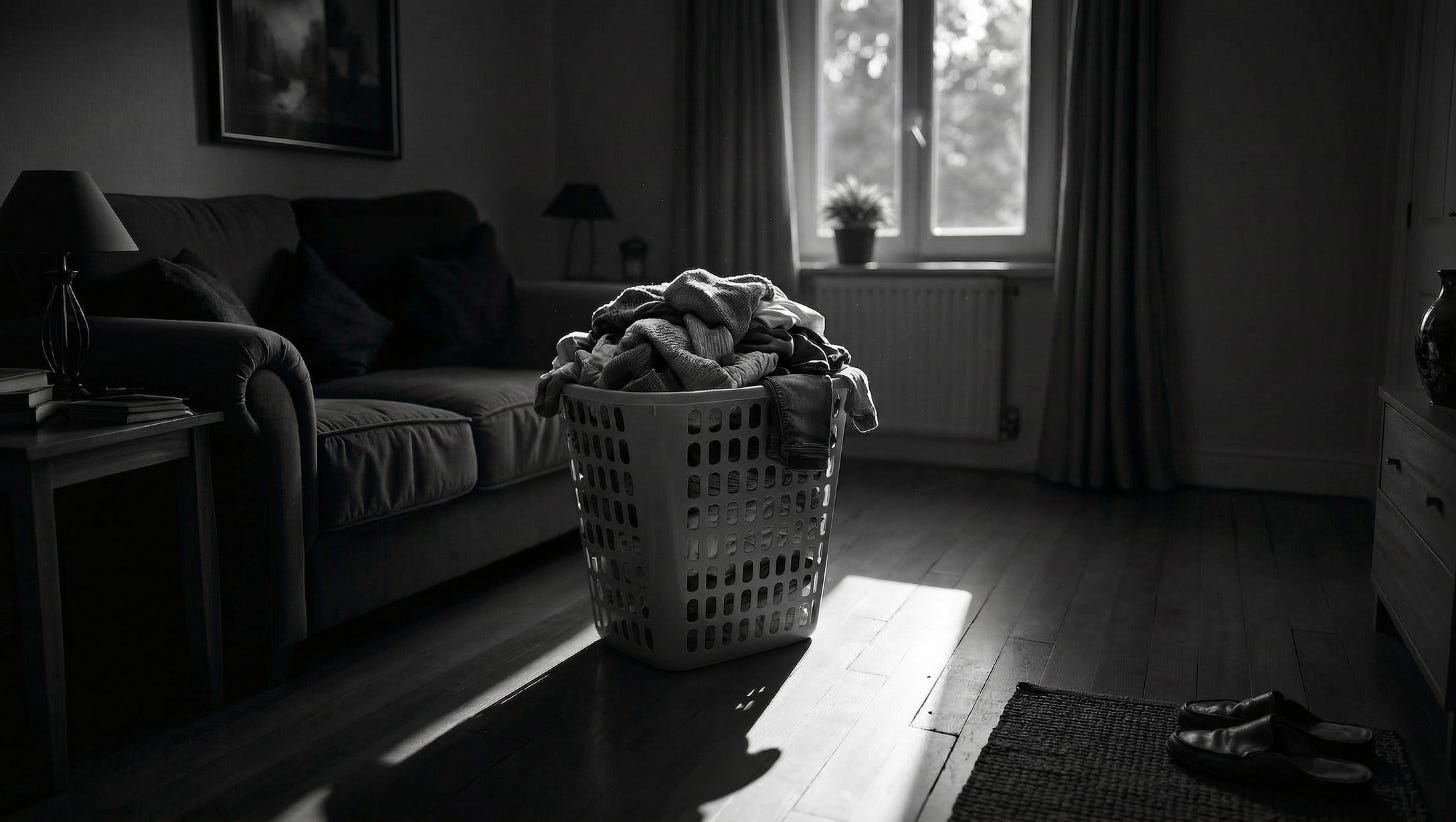
The washing got done. The drying got done. But the folding, the hanging, the actual putting everything where it belonged, that part would stall every single time. Clean clothes piled up in the basket and sat there for days. Sometimes most of the week. Weekends came and I’d find myself on the couch, half-watching something, phone in hand, and the basket was right there. Same room. Close enough to reach. And still it just sat.
There’s a specific kind of internal negotiation that happens in those moments. You see the basket. You register it. And then something in your mind quietly moves the deadline. Not tonight. After this. This weekend for sure. You’re not avoiding it out of some deep character defect. You’re just doing what tired people with no margin do. You’re protecting the one hour you have to breathe. And the basket becomes the thing that can absorb the delay because nothing bad happens immediately when it does.
I had a familiar name for all of it though. Laziness. Not always out loud, but I thought it enough that it started to feel like the honest conclusion. Like I was finally just calling it what it was.
What made it feel honest was that I couldn’t argue with the evidence.
The clothes were right there. I was right there. Nothing was stopping it from happening except that it didn’t happen.
But here’s what didn’t make sense at the time. The same person who couldn’t seem to get the laundry put away was managing other things without much friction at all. Work responsibilities, household decisions, the things that had structure and urgency and consequence around them, they were all getting done. But somehow the laundry didn’t. It wasn’t because folding clothes is harder than managing real pressure. It was because one thing had somewhere to be in the day and one didn’t.
The laundry could wait. And so it did. Every time.
That’s not a character flaw. That’s what an undesigned day produces.
The shift didn’t come from deciding to be better about it. It came from something smaller than that.
Out of pure curiosity, I wanted to know how many steps it would actually take to do all the laundry from start to finish. Walking was already something I was tracking closely, and I just wanted to see the number. So I started counting while I worked, moving back and forth from the bedroom to the closet, the closet to the basket, the basket back through the hall.
That was it. Not a resolution. Not a system overhaul. Just real meaning attached to something that needed to be done.
I ended up with 4,291 steps when it was finished. And the folding got done. Every item. The clothes got put away. It wasn’t because something in me had changed. It was because something in the setup had changed. The laundry connected to something that already mattered to me, my step count, and suddenly it had a reason to happen today instead of sometime this weekend. Weekends were already the hardest days to hit my target. This was exactly the kind of boost I needed to close the gap more consistently.
No decision to be different. Just a different frame around the same task.
That’s when the insight really landed. I wrote it down in my notes and it’s stayed with me since.
Discipline is mostly environment design in disguise.
Most of what we call discipline is not an internal quality some people were born with and others weren’t. It’s a design question. The walks that happen consistently are almost never the result of a decision made in the moment. They’re the result of earlier decisions, made ahead of time, that arranged conditions so the behavior had somewhere natural to land. Those conditions do most of the work. The moment of going is just the last step in something already arranged.
The same is true of the things that don’t happen. They’re not proof something is wrong with you. They’re proof that nothing in the environment is making that behavior easy.
Think about the things in your own life that keep stalling. The workout that never seems to happen. The project you keep meaning to start. The habit you’ve restarted more times than you can count.
Before you decide there’s something wrong with you, it’s worth asking a different question.
Not “why don’t I have more discipline?” but “what would need to be true for this to happen naturally?” What would it need to be connected to? What already matters enough to pull it forward?
That answer is more useful than any amount of self-criticism.
Lazy and disciplined are both real words. They just tend to describe the wrong thing.
What keeps stalling is almost never the person. It’s the conditions the person is operating inside. And conditions are the one thing that can actually be changed. You don’t need a new version of yourself. You need a better arrangement of the life you already have.
The basket is still in the laundry room. Most days it doesn’t wait long anymore. Not because I became someone different. Because the day is arranged differently now.
That’s the whole thing, really.
The person didn’t change. The path did.
If this hit close to home, take one thing you’ve been calling a personal failure and ask what the environment around it actually looks like. You might find a design problem where you’ve been seeing a character flaw.
And if someone came to mind while reading this, pass it along.