

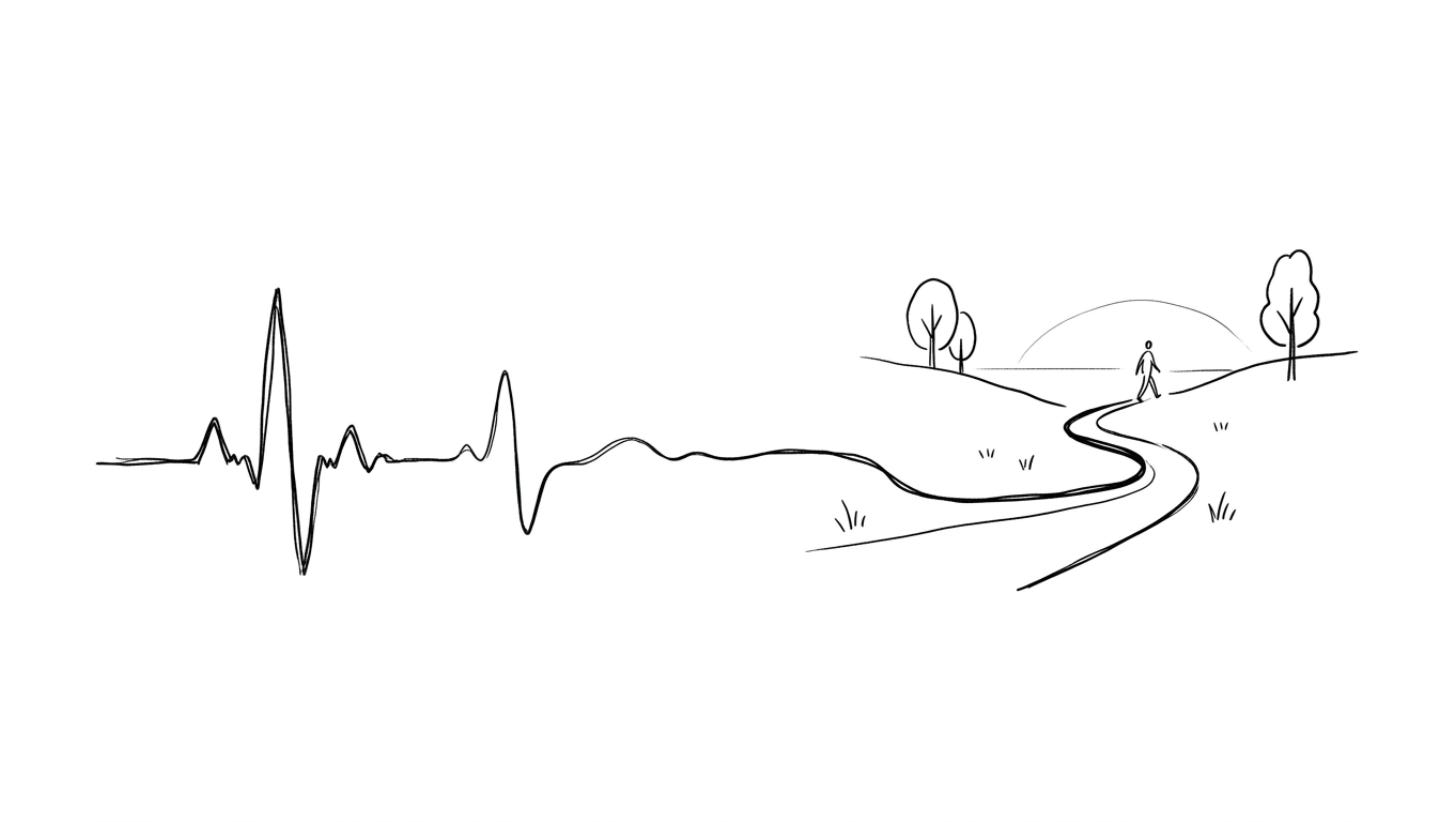
So the doctors did not expect what they found.
After my second heart attack, they took me in to check my arteries. Everybody assumed there had to be a blockage. That’s the pattern they usually see. That’s what they were preparing to find.
There was nothing.
No blockage. Not the first time. Not the second.
I was lying in the hospital bed when they came back with the results. Machines humming softly. Nurses moving quietly through the hall. That kind of stillness that only exists in places where people are waiting for answers.
They explained what they found. I listened quietly, trying to make sense of everything they were telling me.
One of the doctors shook his head slightly and said they couldn’t believe it. Told me it was a rare occurrence to see this happen twice with no blockage.
The room felt tense.
I could see the concern on my wife’s face. My mom was standing nearby, watching the conversation closely. Nobody was quite sure what to say.
And when they finished explaining everything, only one thought settled over me.
I’m still here.
Not with excitement. Not with relief.
With weight.
The kind of weight that doesn’t go away when you get discharged. The kind that rides home with you, sits at the dinner table with you, follows you into every quiet moment when the noise of normal life fades out.
Because if I was still here, it meant something.
I just didn’t know what yet.
So I kept asking. Days turned into weeks. Weeks turned into a slow, ongoing conversation between me and God about what I was supposed to do with the time I’d been given.
And one answer kept coming back.
Walk.
Not run. Not chase some extreme fitness plan. Not overhaul my entire life overnight.
Just walk.
I started walking to take care of the health I had almost lost. But those walks started teaching me something I wasn’t expecting at all.
The Bible talks about life the same way.
Walk in wisdom. Walk in righteousness. Walk by faith.
Scripture rarely describes growth as a sprint. It describes a path people walk over time. And the more I sat with that idea, the more I recognized something in my own story.
Healing doesn’t happen all at once. It happens in stages. And the Bible quietly describes four of them.
1. Seeing the Path
Every journey begins with awareness.
Psalm 1 opens with this observation: “Blessed is the man who does not walk in the counsel of the wicked.”
That verse assumes something important.
Everyone is already walking somewhere.
Life doesn’t wait for you to choose a direction. Your habits, your environment, the decisions you make without even thinking, they’re already forming a path beneath your feet whether you notice it or not.
Growth begins the moment you pause long enough to ask an honest question.
Where is this path actually leading?
That’s where change starts. Not with a new system. Not with a detailed plan. With clarity.
2. Choosing the Path
Once you see the path, the next step is deciding whether to stay on it.
Deuteronomy 30:19 says, “I have set before you life and death… therefore choose life.”
Direction is built from decisions.
The small ones. The daily ones. The ones that seem insignificant at the time.
Every habit you build. Every priority you protect. Every environment you place yourself in. Each one quietly shapes the road you’re walking.
At first those choices feel small. Honestly, sometimes they feel so small they don’t even feel like choices.
But small choices repeated long enough begin to form a clear path.
3. Staying on the Path
This is where most of us struggle.
Not with choosing the path. With staying on it.
Proverbs 4:26 gives a simple instruction: “Watch the path of your feet.”
Not your intentions. Not your plans.
Your feet.
Because the direction of your life is determined by the steps you repeat every single day. Not the dramatic ones. The ordinary ones.
And this is why consistency matters more than intensity. You don’t need perfect days.
You need faithful steps.
One walk today. Another tomorrow. Then one more the day after.
Those steps, accumulated over time, shape the direction of your life more than any single decision ever could.
4. Becoming the Path
Then something shifts.
The walk stops feeling forced. It becomes who you are.
Your discipline becomes visible. Not announced in a loud way, but in our ability to keep going when most people would have stopped. That kind of consistency starts to carry weight beyond your own life.
It begins to influence the people around you without you even trying.
Jesus described it this way in Matthew 5:16: “Let your light shine before others.”
At this stage, your steady steps quietly become a path others feel the pull to walk also.
When people think about changing their lives, they usually look for something dramatic.
A breakthrough. A turning point. A single moment that decides everything.
But the Bible describes something quieter.
A walk.
One step. Then another. Then another.
I didn’t expect to find that lesson in a hospital room. But that’s where it started for me. Lying still, staring at the ceiling, with the weight of still being here pressing down in a way that had nothing to do with my heart.
Looking back now, I can see it for what it was.
A calling.
The direction of your life is rarely decided in a single moment.
It’s decided by the path you keep walking.
Take the next step.
Because the path is always built the same way.
One step at a time.
That’s fascinating Clinton that the doctors didn’t find a blockage in either of your heart attacks.
The good news is that the wake up call your body gave you was acted upon!